What are Jump Cuts mainly used for?
Jump costs are usually used when recording is in order. This is to prepare for a cutting point between consecutive shots - such as cutting from a wide shot in a scene to closer coverage - vary both the size and angle of the shot.
- Some filmmakers deliberately choose not to vary the size and angle of the second shot which results in the cut having a jarring effect, literally jumping in what often feels like an awkward way from one shot to the next.
Filmmakers use jump cuts for several reasons:
- Rebellion
- French New Wave filmmakers used jump cuts in the 50s to break from the traditional dominance of continuity editing.
- Pace
- Jump cuts can be used to add a sense of speed to the sequence of events.
- Psychological
- Jump cuts can be used to suggest the non-linear way the human mind works.
Here is two movie examples of Jump cuts.
In my opinion the editor has used Jump cuts to hurry up the action, this may be to reduce the length of the film. This is not stereotypical in the sense of the movie industry, and its what makes the movie stand out from opposing films.
The first movie was [Snatch] by Guy Ritchie 2000, in this movie it seems there is a robbery of jewels, in the action it jumps backwards and forwards. A group of men in the olden days dressed up, which seems civil but then out of no where guns are pulled out and many jump cuts begin to create suspense.
The second movie was [Old boy] by Chan-wood Park 2003, this movie is a mature middle aged man who seems to have got in trouble by the police, he makes jokes, and while this is happening the Director has decided to jump backwards and forwards within the scenes.
Tuesday, 19 April 2016

Monday, 18 April 2016
Motivated
Motivated
What is it used for?
- In mainstream cinema, especially in the west, editorial motivation supports continuity.
- A [motivated] edit refers to cuts that are motivated by some purpose (story, character, emotion, suspense).
- A motive is a reason for doing something.
- With motivated editing something that occurs in shot A will be the reason for picking shot B, so the first shot provides the motive for the next shot.
The motivation can be for a variety of reasons:
- Flashbacks
- Exposition
- To see something that a character is seeing
- To show who is talking in a conversation
Why is the motivated edit used by editors?
- The story calls the shots - the editors let the story remain the focus for the audience, rather than unimportant details.
- In mainstream cinematic narratives, emphasis is put on the story being told in a logical and clear way.
- Seamless editing helps an audience suspend its disbelief.
- Motivated editing complements continuity editing by allowing the story to dictate what the audience sees.
Motivated Edit:
(https://www.youtube.com/watch?v=tFt301376os)
Sunday, 17 April 2016
Storyboard Analysis

Task:
My task was to create a three boxes storyboard suggesting how you can do three slides without any context, but the pictures will explain what is actually happening.
With this I wanted to represent that there was students in a classroom and you can see in the first box there are two people, maybe teenagers talking, then I move on in the next box to a medium shot on the two talking, but in the third I wanted to make it obvious by using the black crow that automatically meant death and you can see one of the people laying dead on the floor in a pool of blood.
However, a peer took a look and had a totally different way of seeing it. They said they thought that the first box was a mother watching her children. The second box, was children playing, and lastly, one of them dies.
What I was trying to show and how it was looked at different made me think that, we don't all think alike. This creates our own creativity when it comes to productive tasks such as this one.
Saturday, 16 April 2016
Engaging the viewer
Production value:
 Certain shots will have been filmed in order to maximise the sensory experience for the viewer.
This can be achieved through:
- Wide shots which present a panorama of a setting or communicate the scale of an action spectacle.
- Aerial shots which follow action while taking in an entire geography.
- Crane shots which can scale buildings.
- Bullet time camera-setups which allow the viewer to experience a moment of action frozen in time from 360 degrees.
 Variation of shot distance and camera angle. Audiences enjoy and expect variation of shot distance and camera angle.
- At some point during the action of scene the audience will want to have the setting established in order to get a sense of space and proxemics and to infer things about the area.
- There is an expectation, in both mainstream and independent films, that during key dramatic beats in a scene, the audience will want close coverage of the action. This might involve a will want close coverage of the action. This might involve a close-up of a character's face, in order to reveal emotional as a book, a weapon or a phone, in order to reveal informational detail.
- POV shots immerse the audience in a particular character's experience of the action. Depending on the genre, such shots can be very useful to an editor where the aim is to build tension and suspense.
Varying editorial pace:
Audiences like to feel changes in the shape of editorial pacing;
- Changing pace [speeding up or slowing down editorial pace can create tension] (depending on the context)
- Long takes can also be used to create a sense of naturalism (real time passing) [which can engage an audience by giving the sense of being immersed in a real life situation.

This can be achieved through:
- Wide shots which present a panorama of a setting or communicate the scale of an action spectacle.
- Aerial shots which follow action while taking in an entire geography.
- Crane shots which can scale buildings.
- Bullet time camera-setups which allow the viewer to experience a moment of action frozen in time from 360 degrees.

- At some point during the action of scene the audience will want to have the setting established in order to get a sense of space and proxemics and to infer things about the area.
- There is an expectation, in both mainstream and independent films, that during key dramatic beats in a scene, the audience will want close coverage of the action. This might involve a will want close coverage of the action. This might involve a close-up of a character's face, in order to reveal emotional as a book, a weapon or a phone, in order to reveal informational detail.
- POV shots immerse the audience in a particular character's experience of the action. Depending on the genre, such shots can be very useful to an editor where the aim is to build tension and suspense.
Varying editorial pace:
Audiences like to feel changes in the shape of editorial pacing;
- Changing pace [speeding up or slowing down editorial pace can create tension] (depending on the context)
- Long takes can also be used to create a sense of naturalism (real time passing) [which can engage an audience by giving the sense of being immersed in a real life situation.
Friday, 15 April 2016
Development of Drama
Conflict:
- Having conflict is essential in drama, whether it be a short film or a full film involved with drama.
External conflict:
- This can be the weather, or even if an alien invasion were to happen. Or even super heroes fighting, they are both each others external conflict.
 - Encounters between protagonist who has a dramatic need in the scene and an antagonist, who opposes that need in the scene.
- When things come to a head the editor will often rely on the editorial technique of shot-reverse-shot to move back and forth between the two characters.
- Showing the audience a character in close-up will immerse the viewer in the burgeoning emotion in that character; at the same time, the viewer will be anticipating the reaction of the off-screen agent in the exchange.
Withholding information:
- Audiences enjoy suspense in all its various forms. They like to be teased and challenged.
- Withholding a character's identity at a key moment challenges an audience to make intelligent guesses.
- Cutting away from a scene (for example cross cutting to another scene) invites the audience to imagine how the action in the first scene might be continuing.

 Internal conflict:
- When the protagonist is involved in a battle with himself or herself [feeling two opposing needs] internal conflict arises.
- The editor may favour close coverage to capture this internal struggle.
- Shots will be selected which focus on eyes and mouth to show feelings of discomfort/ unease/ tension or on other bodily parts such as hands, feet to show signs of strain and tension, in the hope that the viewer will vicariously feel the same struggle.
- Having conflict is essential in drama, whether it be a short film or a full film involved with drama.
External conflict:
- This can be the weather, or even if an alien invasion were to happen. Or even super heroes fighting, they are both each others external conflict.
 - Encounters between protagonist who has a dramatic need in the scene and an antagonist, who opposes that need in the scene.
- When things come to a head the editor will often rely on the editorial technique of shot-reverse-shot to move back and forth between the two characters.
- Showing the audience a character in close-up will immerse the viewer in the burgeoning emotion in that character; at the same time, the viewer will be anticipating the reaction of the off-screen agent in the exchange.
Withholding information:
- Audiences enjoy suspense in all its various forms. They like to be teased and challenged.
- Withholding a character's identity at a key moment challenges an audience to make intelligent guesses.
- Cutting away from a scene (for example cross cutting to another scene) invites the audience to imagine how the action in the first scene might be continuing.
 Internal conflict:
- When the protagonist is involved in a battle with himself or herself [feeling two opposing needs] internal conflict arises.
- The editor may favour close coverage to capture this internal struggle.
- Shots will be selected which focus on eyes and mouth to show feelings of discomfort/ unease/ tension or on other bodily parts such as hands, feet to show signs of strain and tension, in the hope that the viewer will vicariously feel the same struggle.
Thursday, 14 April 2016
Creating Pace
Pace:
An editor can create pace in a scene by moving from:
- Longer takes to shorter takes
- A few cuts in a given stretch of film time to many cuts in a given stretch of film time.
An editor might increase the pace in a scane to communicate:
- Rising action
- Diminishing time
- Mounting tension
- Heightening of stakes


This YouTube video which is Fan-Made and is Dead pool and an avenger movie is an example of pace. The sequence starts with a beginning of a fight which about to incur, in the beginning of the fight the takes tend to be longer. The takes begin to get shorter in length when the action gets more entailed with explosions and bullets being fired. The editor has done this to keep the audience entertained and aware of what all actors within the fighting scene are doing, for example; each Avenger within the scene the camera rotates between them almost to give their POV (Point of View) of the situation in which they are all facing from personal perspective. Towards the end of the scene many cuts occur in a relatively short space of screen time. The editor uses a high level of shots to allow the audience to be aware of everything that is happening to each character, and shows each owns individual perspective.
Wednesday, 13 April 2016
Combining shots into Sequences
Shots into Sequences:
The editors primary responsibility is to cut selected shots together in such a way that the story told in the script and captured through image, sound and performance in production is preserved.
This is achieved in all genres by establishing settings with wider shots, exploring character dynamics with medium coverage and emphasising key detail - a fuse, a grimace, a coordinate - with closer coverage.
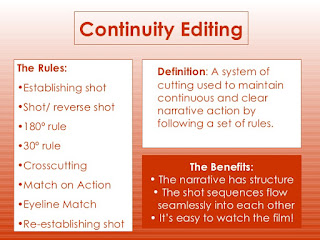 Broadly speaking, shots are combined into sequences in two ways:
- Continuity editing aims to make cuts invisible in order to achieve a seamless, fluid rendering of the story through successive shots and sequences drawing any attention to the editing itself.
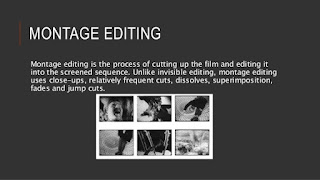
- Montage editing makes the editing process more conspicuous by juxtaposing less clearly related material, challenging viewers to make abstract connections between shots and sequences.
The choice of shots by the editor can create meaning in certain scenes.
This is an example of Combining shots into sequences:
The editors primary responsibility is to cut selected shots together in such a way that the story told in the script and captured through image, sound and performance in production is preserved.
This is achieved in all genres by establishing settings with wider shots, exploring character dynamics with medium coverage and emphasising key detail - a fuse, a grimace, a coordinate - with closer coverage.
 Broadly speaking, shots are combined into sequences in two ways:
- Continuity editing aims to make cuts invisible in order to achieve a seamless, fluid rendering of the story through successive shots and sequences drawing any attention to the editing itself.

- Montage editing makes the editing process more conspicuous by juxtaposing less clearly related material, challenging viewers to make abstract connections between shots and sequences.
The choice of shots by the editor can create meaning in certain scenes.
This is an example of Combining shots into sequences:
Subscribe to:
Posts (Atom)